Draw a Filled-in Circle Mathematica
Preface
This section addresses a buitiful application of Mathematica to plot figures with fillings. Therefore, this department presents numerous examples.
Return to computing page for the first course APMA0330
Return to computing folio for the second class APMA0340
Render to Mathematica tutorial for the first form APMA0330
Return to Mathematica tutorial for the second course APMA0340
Render to the chief folio for the grade APMA0330
Return to the chief folio for the course APMA0340
Return to Function I of the course APMA0330
Plotting with filling
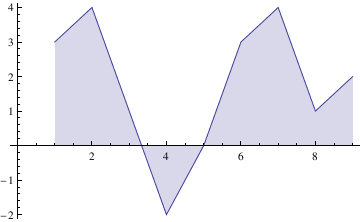 | We repeat the previously considered example for a piecewise linear role with filling: Plot[2 - 2*ten, {x, 0, ane}, FillingStyle -> Light-green, Filling -> Bottom] | |
| Piecewise linear function | Mathematica code |
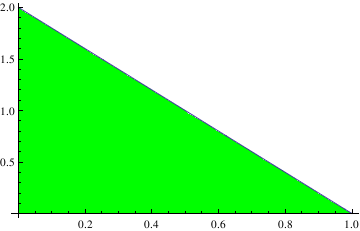 | Now we change the colour of filling: Plot[2 - 2*x, {ten, 0, 1}, FillingStyle -> Green, Filling -> Bottom] | |
| Example of green color filling. | Mathematica code |
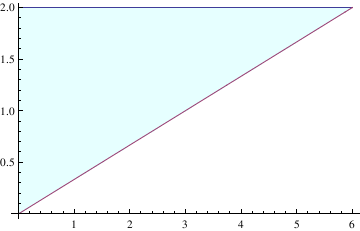 | Now we change the colour of filling: Plot[{2, (x/3)}, {x, 0, 6}, Filling -> {one -> {ii}}, FillingStyle -> LightCyan] | |
| Example of light cyan color filling. | Mathematica code |
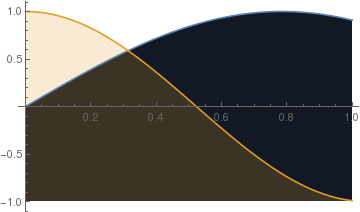 | This specifies a specific filling to be used only for the showtime curve. Plot[{Sin[2*x], Cos[3*ten]}, {x,0,1}, Filling -> {ane -> 0.5}] | |
| Ii curves with singled-out fillings. | Mathematica code |
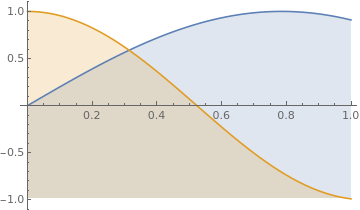 | Plot[{Sin[2*10], Cos[iii*x]}, {x, 0, 1}, Filling -> Bottom] | |
| Region between sine and cosine functions. | Mathematica lawmaking |
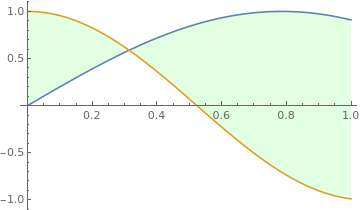 | Some other color of filling: Plot[{Sin[2*x], Cos[3*10]}, {x, 0, 1}, Filling -> {ane -> {2}}, FillingStyle -> LightGreen] | |
| Region betwixt sine and cosine functions. | Mathematica code |
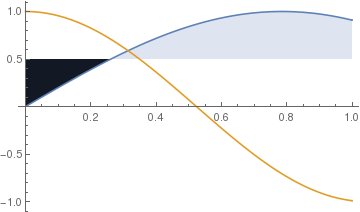 | This code specifies a specific filling to be used just for the first bend. Plot[{Sin[2*ten], Cos[3*ten]}, {x,0,1}, Filling -> {1 -> 0.5}] | |
| Simply i part of the region is specified. | Mathematica lawmaking |
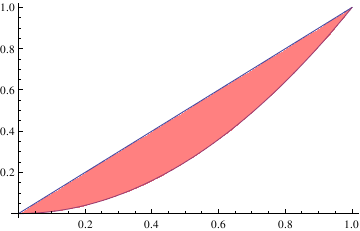 | Plot[{10, x^ii}, {10, 0, ane}, Filling -> {one -> {two}}, FillingStyle -> Pinkish] | |
| Region betwixt 2 curves. | Mathematica lawmaking |
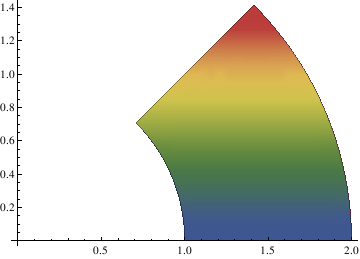 | At present we modify the colour of filling: Bear witness[PolarPlot[{i, 2}, {t, 0, Pi/four}], RegionPlot[ 10^2 + y^2 >= 1 && ten^2 + y^2 <= 4 && y/ten <= 1, {10, 0, 2}, {y, 0, 2}, ColorFunction -> "DarkRainbow"]] | |
| Example of PolarPlot. | Mathematica code |
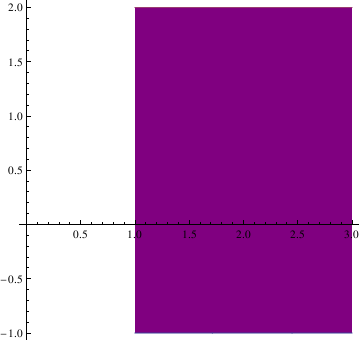 | Plot[{-1, 2}, {x, 1, 3}, Filling -> {i -> {ii}}, FillingStyle -> Purple, AspectRatio -> Automated, AxesOrigin -> {0, 0}] | |
| Rectangle. | Mathematica code |
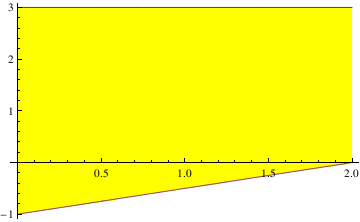 | Plot[{three, (ten/ii) - one}, {x, 0, 2}, Filling -> {one -> {2}}, FillingStyle -> Yellow] | |
| Figure with filling. | Mathematica code |
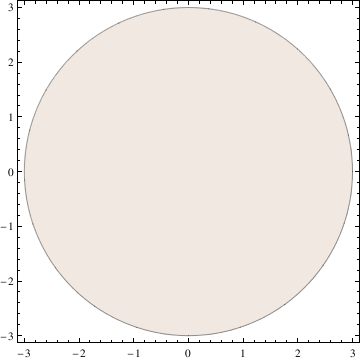 | RegionPlot[{x^2 + y^ii <= 9}, {x, -three, 3}, {y, -3, 3}, PlotStyle -> LightBrown] | |
| Figure with filling. | Mathematica code |
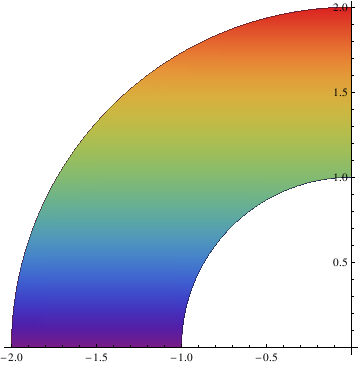 | Show[PolarPlot[{one, two}, {t, Pi/two, Pi}], RegionPlot[x^two + y^two >= 1 && ten^2 + y^2 <= 4, {x, -two, 0}, {y, 0, 2}, ColorFunction -> "Rainbow"]] | |
| Part of a circumvolve with filling. | Mathematica code |
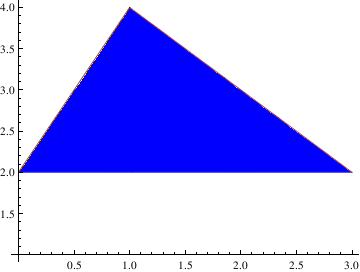 | To lift a traingle over the horizontal axis, type: tr = Plot[{1., Max[one, Min[two ten + 1, 4 - x]]}, {ten, 0, 3}, AspectRatio -> i/2, Ticks -> {{0, 1, 2, 3}, {0, 1, ii, 3}}, | |
| Triangle is lifted over the centrality. | Mathematica code |
RegionPlot[Sin[x y] > 0, {x, -1, 1}, {y, -1, 1},
FrameTicksStyle -> Directive[FontOpacity -> 0, FontSize -> 0]]
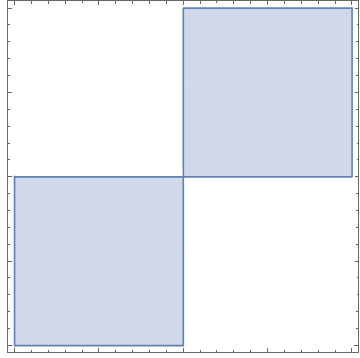
When plotting, you still see frameticks data:
rp = RegionPlot[x^ii + y^three/four < 2 && x + y < i, {x, -2, 2}, {y, -2, 2}, FrameTicks -> Automated]
First extract the frameticks information and change the labels to blank:
newticks = Final@Commencement[AbsoluteOptions[rp, FrameTicks]];
While Mathematica complains nigh that Ticks: {Automatic,Automatic} is not a valid tick specification, information technology notwithstanding does its job. next nosotros type:
Evidence[rp, FrameTicks -> newticks]
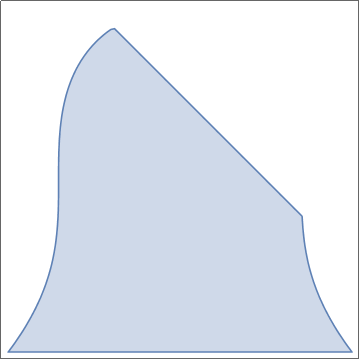
You may as well try
newticks = Last@Start[AbsoluteOptions[rp, FrameTicks]];
newticks[[All, All, 2]] = "";
but Mathematica will complain again and out will be the same.
RegionPlot[1 < Abs[ten + I y] < 2, {x, -2, 2}, {y, -2, 2}, ImagePadding -> 1]
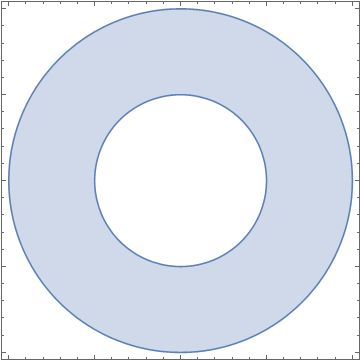
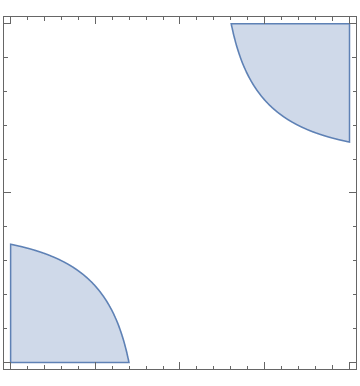
| | Another example: Graphics3D[{Texture[img], EdgeForm[], Cylinder[{{0, 0, 0}, {0, 0, ii Pi}}, one]}, Boxed -> False] | |
| Two pieces of a circumvolve. | Mathematica lawmaking |
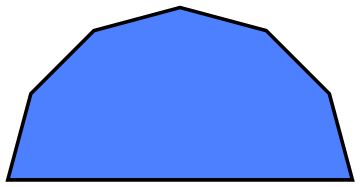
We plot half of the polygon:
poly = Polygon[Table[North[{Cos[due north *Pi/half-dozen], Sin[n*Pi/half dozen]}], {northward, 0, 6}]]
Graphics[{RGBColor[0.3, 0.5, ane], EdgeForm[Thickness[0.01]], poly}]
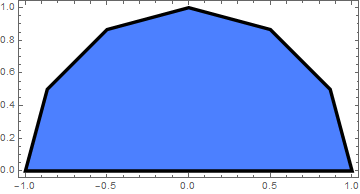
Evidence[%, Frame -> True]
Parametric Plots with fillings
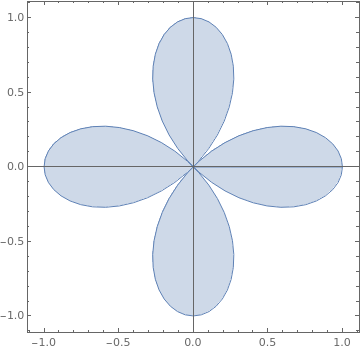
| | ParametricPlot[ Cos[two theta] {Cos[theta], Sin[theta]} r, {theta, 0, 2 Pi}, {r, 0, 1}, Mesh -> Imitation, PlotPoints -> {30, 2}] | |
| Iv cusp curve r = cos(2 θ). | Mathematica code |
| | g1 = PolarPlot[Cos[two theta], {theta, Pi/four, 2 Pi - Pi/iv}]; | |
| Function of the curve r = cos(2 θ). | Mathematica code |
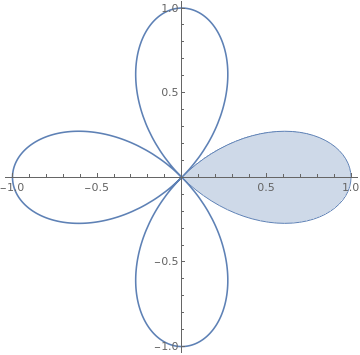
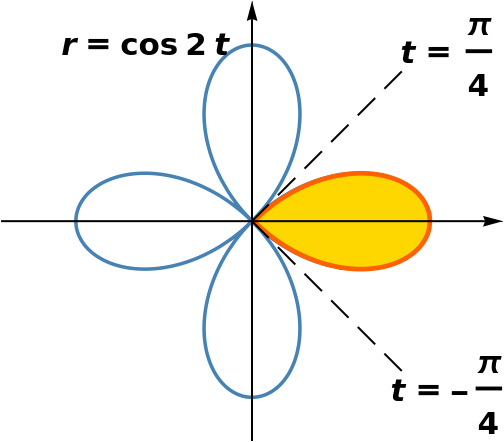
| | txt[t_, {x_, y_}] := Fashion[Text[t, {10, y}], FontSize -> 30, FontWeight -> Assuming] {xmin, xmax} = {-ane.425, i.425}; {ymin, ymax} = {-1.25, ane.25}; | |
| One cusp from the curve r = cos(two θ). | Mathematica code |
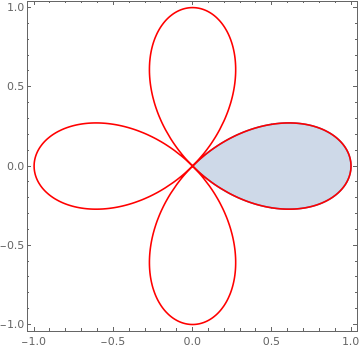
| | Another version: Show[{RegionPlot[(x^2 + y^2)^(1/ii) <= Cos[2 ArcTan[y/x]], {ten, 0, 1}, {y, -i/2, 1/ii}], PolarPlot[Cos[2 theta], {theta, 0, ii Pi}, PlotStyle -> Red]}, PlotRange -> All] orShow[{RegionPlot[(x^2 + y^ii)^(3/2) <= x^2 - y^2, {x, 0, 1}, {y, -1/ii, i/2}], PolarPlot[Cos[ii theta], {theta, 0, 2 Pi}, PlotStyle -> Red]}, PlotRange -> All] orPolarPlot[Cos[ii theta], {theta, 0, 2 Pi}, PlotStyle -> Red, Prolog -> RegionPlot[(ten^ii + y^ii)^(3/2) <= x^ii - y^2, {10, 0, ane}, {y, -1/2, 1/2}][[i]]] or s = PolarPlot[Cos[2 theta], {theta, 0, two Pi}]; | |
| 1 cusp from the curve r = cos(ii θ). | Mathematica code |
Polar plots with fillings
I fashion to go around a problem to make plots with filling is to use ParametricPlot
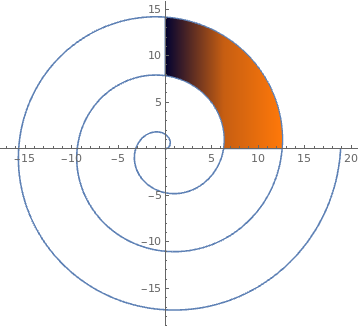
| | parmplot = ParametricPlot[ r {Cos[t], Sin[t]}, {t, 0, Pi/2}, {r, 2 Pi + t, 4 Pi + t}, ColorFunction -> "RustTones"]; | |
| Archimede's spiral. | Mathematica code |
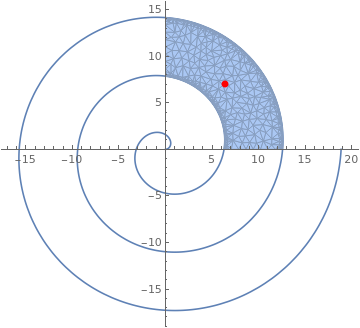
| | cartreg = ImplicitRegion[ 2 \[Pi] < Sqrt[x^2 + y^2] - ArcTan[x, y] < 4 \[Pi] && 0 <= x <= 15 && 0 <= y <= 15, {x, y}]; | |
| Archimede'due south spiral with a dot. | Mathematica lawmaking |
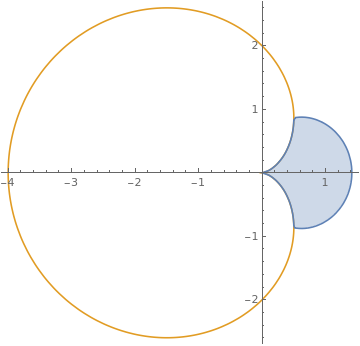
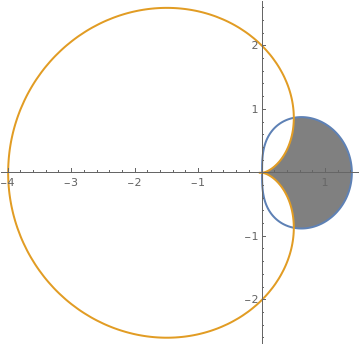
| | Show[PolarPlot[ Evaluate[{{1, -ane} Sqrt[ii Cos[t]], 2 (one - Cos[t])}], {t, -\[Pi], \[Pi]}], RegionPlot[ Sqrt[x^2 + y^ii] > 2 (i - Cos[ArcTan[x, y]]) && Sqrt[ten^two + y^ii] < Re@Sqrt[2 Cos[ArcTan[10, y]]], {x, -ii, 2}, {y, -3, iii}], PlotRange -> All] | |
| Shading between polar graphs. | Mathematica code |
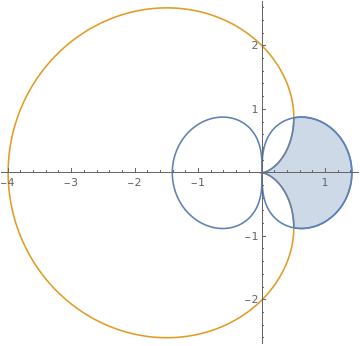
| | Another plot: Show[PolarPlot[{Sqrt[2 Abs[Cos[t]]], 2 (1 - Cos[t])}, {t, -\[Pi], \[Pi]}], RegionPlot[ four (ane - Cos[t])^2 < r^ii < 2 Cos[t], {r, 0, three}, {t, -Pi, Pi}, PlotPoints -> 30] /. GraphicsComplex[a_, b__] :> GraphicsComplex[#1 {Cos[#2], Sin[#2]} & @@@ a, b]] | |
| Shading between polar graphs. | Mathematica code |
| | Using Cartesian coordinates: eqns[t_] := {Sqrt[2 Cos[t]], 2 (1 - Cos[t])}; | |
| Shading between polar graphs. | Mathematica code |
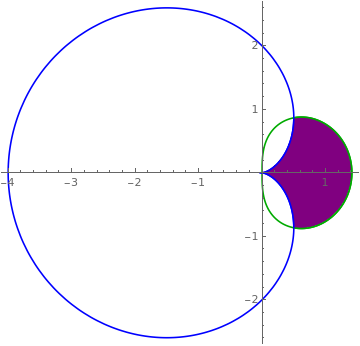
| | Yous can parameterize your polar functions on to discs, and then shade appropriately. \[Rho][t_] := Sqrt[2 Cos[t]]; | |
| Shading between polar graphs. | Mathematica lawmaking |
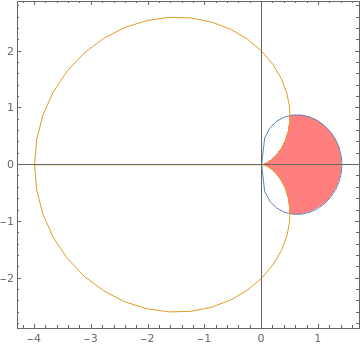
| | Some other version: dt = Pi/99; | |
| Shading betwixt polar graphs with contours. | Mathematica code |
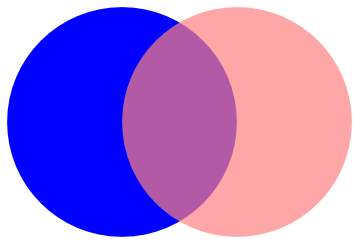
Filling circles can be plotted using Graphics cammand. Graphics are represented equally symbolic expressions, using
either"directives" or "styles":
Graphics[{Blue, Disk[{0, 0}], Opacity[0.7], Pink, Disk[{1, 0}]}]
Graphics[{Mode[Disk[{0, 0}], Greenish], Opacity[0.5], Pink, Deejay[{1, 0}]}]
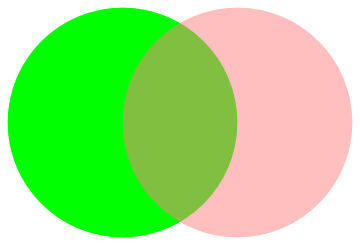
We tin plot Venn diagrams using the following subroutine
VennDiagram2[n_, ineqs_: {}] :=
Module[{i, r = .6, R = ane, five, grouprules, x, y, x1, x2, y1, y2, ve},
five = Table[Circle[r {Cos[#], Sin[#]} &[ii Pi (i - one)/due north], R], {i, north}];
{x1, x2} = {Min[#], Max[#]} &[ Flatten@Replace[five, Circumvolve[{xx_, yy_}, rr_] :> {20 - rr, xx + rr}, {1}]];
{y1, y2} = {Min[#], Max[#]} &[ Flatten@Replace[v, Circle[{xx_, yy_}, rr_] :> {yy - rr, yy + rr}, {1}]];
ve[x_, y_, i_] := v[[i]] /. Circle[{xx_, yy_}, rr_] :> (x - xx)^ii + (y - yy)^two < rr^2;
grouprules[x_, y_] = ineqs /. Tabular array[With[{is = i}, Subscript[_, is] :> ve[ten, y, is]], {i, n}];
Show[If[MatchQ[ineqs, {} | False], {}, RegionPlot[grouprules[x, y], {ten, x1, x2}, {y, y1, y2}, Axes -> False]],
Graphics[v], PlotLabel -> TraditionalForm[Supplant[ineqs, {} | Imitation -> \[EmptySet]]], Frame -> Faux]]
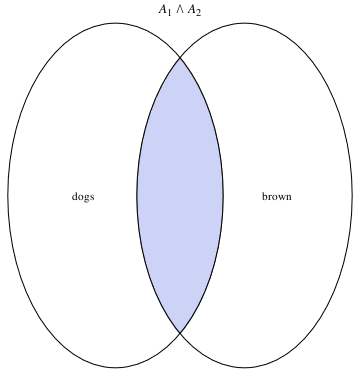
Then we plot two Venn diagrams:
a12 = VennDiagram2[2, Subscript[A, 1] && Subscript[A, 2]]
a1 = Graphics[Text[dogs, {-0.9, 0}]]
b1 = Graphics[Text[brown, {0.9, 0}]]
Evidence[a12, a1, b1]
or
a32 = VennDiagram2[2, Not[Subscript[A, 1]] && Subscript[A, 2]]
a33 = VennDiagram2[2, Non[Not[Subscript[A, 1]] && Subscript[A, ii]]]
Return to Mathematica folio
Return to the primary page (APMA0330)
Return to the Role 1 (Plotting)
Return to the Part 2 (Kickoff Order ODEs)
Return to the Part 3 (Numerical Methods)
Render to the Part 4 (Second and Higher Gild ODEs)
Return to the Part 5 (Series and Recurrences)
Return to the Part 6 (Laplace Transform)
Return to the Office vii (Purlieus Value Problems)
Source: https://www.cfm.brown.edu/people/dobrush/am33/Mathematica/ch1/venn.html
0 Response to "Draw a Filled-in Circle Mathematica"
Post a Comment